

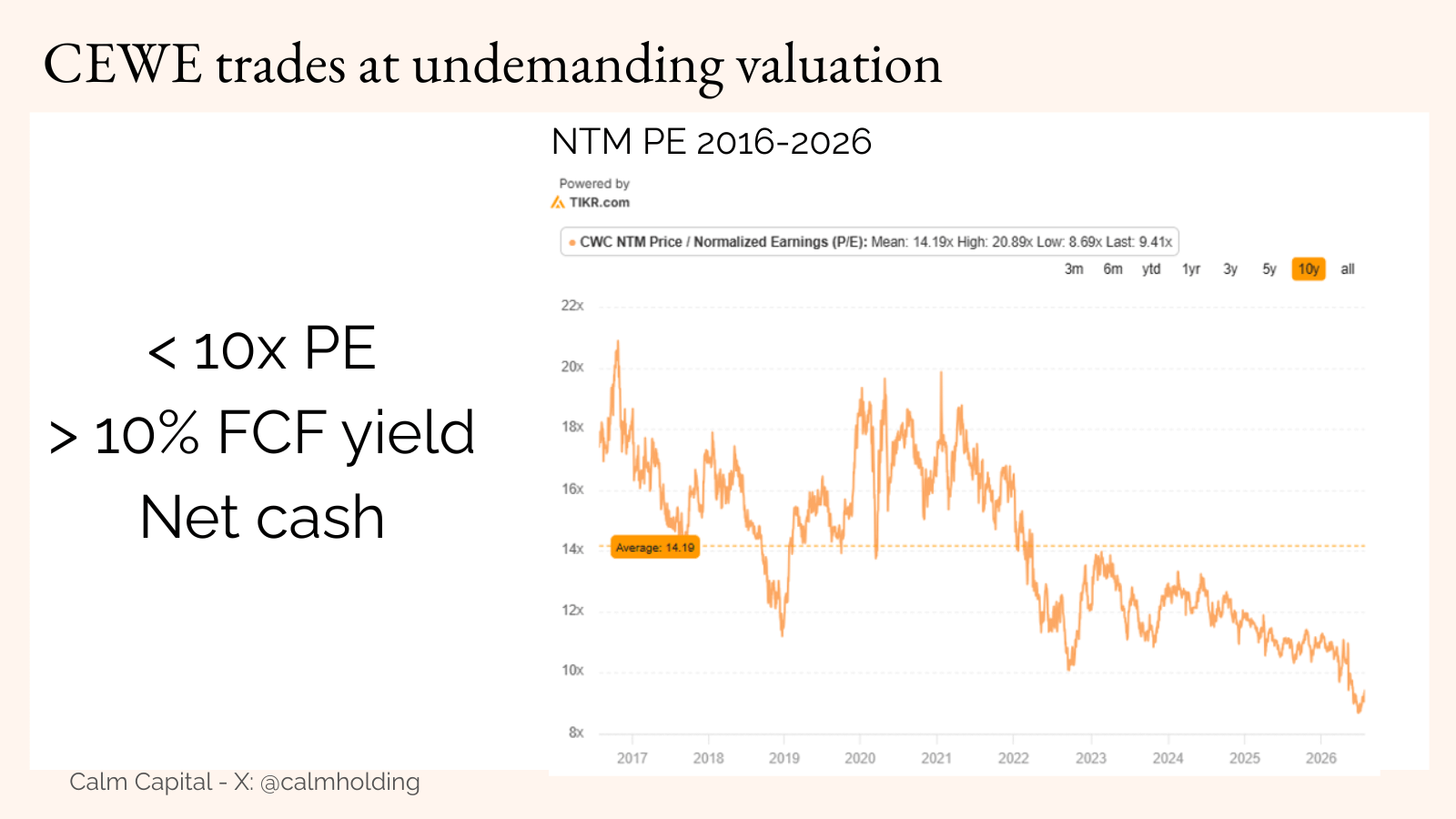
CEWE is a niche market leader with good returns on capital and a net cash position, trading below 10x earnings and at a FCF yield above 10%.
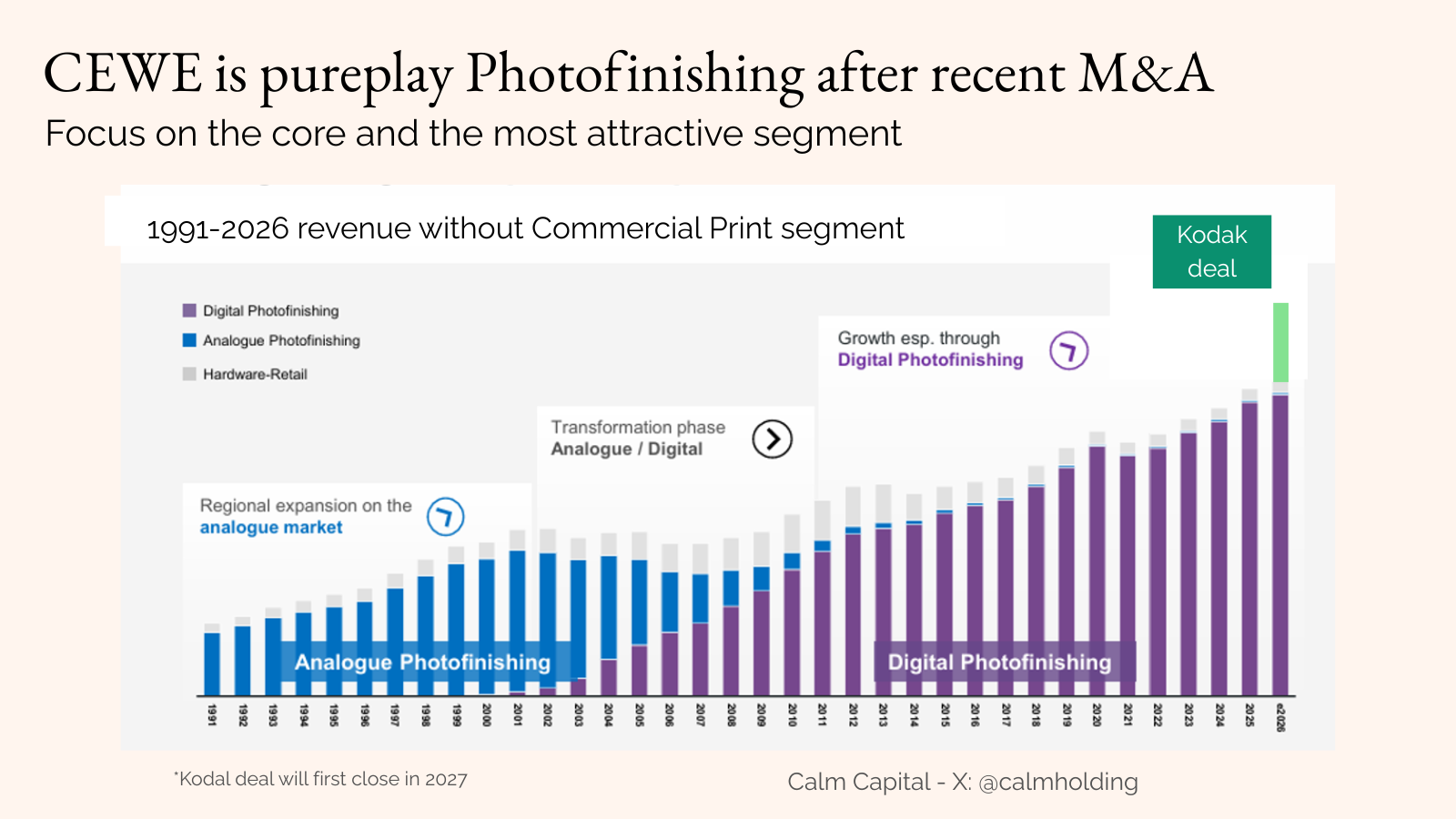
Recent M&A makes it a pure play on photofinishing, the most profitable part of the business, with 10-year historical sales and EBIT CAGRs of 6% and 8%.
A number of misconceptions create an interesting opportunity. The market values CEWE as a business with little to no earnings growth in a slowly dying industry. Recent governance concerns overshadow the company’s long-term focus on value creation. And the attractiveness of recent acquisitions is also not reflected in the share price.
“As long as people travel and as long as Christmas does exist, this business will be healthy.”
CEO Thomas Mehls, marts 2026 earnings call
This is not investment advice. Do your own research and see the full disclaimer. I own shares in CEWE.
Company Introduction
CEWE is the European market leader in photofinishing. They sell photo books, calendars and other customized photo products, and have managed the transition from analogue to digital and from prints to higher-value products.
They hold strong positions across a number of European countries, especially in the DACH region and in the high-end segments. Germany makes up 50% of total revenue.
CEWE has a conservative balance sheet with a large cash position and no financial debt (though some lease obligations and a pension deficit). The largest shareholder is the founding family and the company is controlled by a foundation, unlike most other large players in the industry, which are PE-owned.
The business has low cyclicality but high seasonality: Q4, driven by Christmas, accounts for a large part of sales and essentially all of the profit. The product is a low-cost, high-meaning gift, so demand holds up well even in weaker economic periods. As CEO Thomas Mehls put it on the March 2026 earnings call: “As long as people travel and as long as Christmas does exist, this business will be healthy.”
Competitive advantages
CEWE owns several strong brands: CEWE, Pixum, Cheerz (app-first, younger segment) and Whitewall (professional and gallery). The customer base is large and ratings are high across platforms and trust is important in the gifting segment.
CEWE handles 99% of production in-house, while several smaller app-first players rely on external production. That lets it manage peak Q4 ordering efficiently, deliver reliably and add premium features to its products.
They also run an omnichannel setup with more than 25,000 in-store photo stations at retail partners, an entry point for higher-end products made at CEWE’s own plants.
Premiumization has been the main growth driver, now volume is growing too
CEWE has a long track record of premiumization and value-added features. Since 2013, the number of photos handled and photo books sold has grown only 10%, while value per photo has grown 81%. They convert more photos into value-added products like calendars, sell longer and more premium photo books, and add small features that lift price (the memory pocket (+4.5 EUR) or the panorama fold-out page (+5 EUR)).
Both photo volume and the number of photo books have started growing in the last couple of years. This matters, since value per photo cannot keep rising forever.
Smaller app-first competitors (Popsa, OnceUpon, Freeprints) have grown quickly, increasing competition and likely weighing on CEWE’s volume growth. Some have struggled to scale and growth has slowed. They lack in-house production and likely carry higher customer acquisition costs.
CEWE photo volume and value per photo 2013-2025

Selected Financial
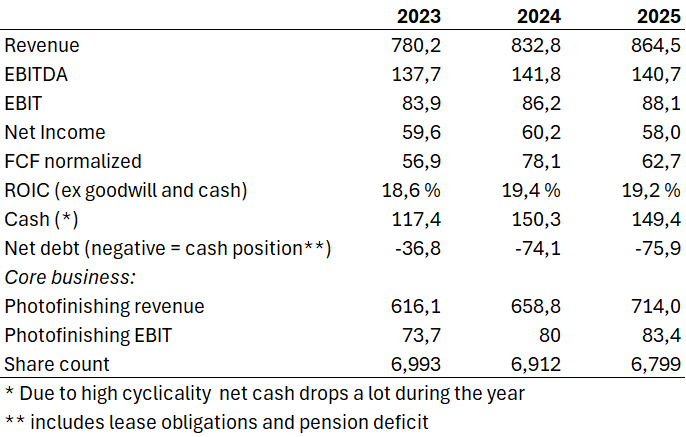
CEWE earns close to 20% ROIC (ex-cash and goodwill) and has attractive cash conversion, with normalized FCF above net income. At a market cap of 640 mEUR, the stock trades at a 10%+ normalized FCF yield and around 9x 2027 earnings.
Cash was 150 mEUR at FY2025 year-end, but seasonality means it falls sharply during the year: the Q3 2025 low point was 49 mEUR.
Net income has been flat for three years, but the core business has kept growing. The announced M&A focuses the company on that core, photofinishing.
Selected misconceptions:
Misconception #1: The business has no earnings growth, and digital pictures will slowly kill physical products.
Underlying growth in the core business has been masked by the Covid reset and non-core earnings fluctuations.
Reported net income is down 3% from 2023 to 2025 on declining commercial printing profit (now sold off), lower financial income (2023 included gains on start-up equity investments) and a higher-than-usual tax payment in 2025. Over the same period, the core business grew EBIT by 13% and revenue by 16%.
Five-year net profit growth is only 11.6% (2.2% CAGR). Besides the reasons above, this reflects Covid: 2020 was very profitable, as people had time to go through old pictures, while 2021 and 2022 suffered as travel restrictions left customers with nothing new to put in a photo book.
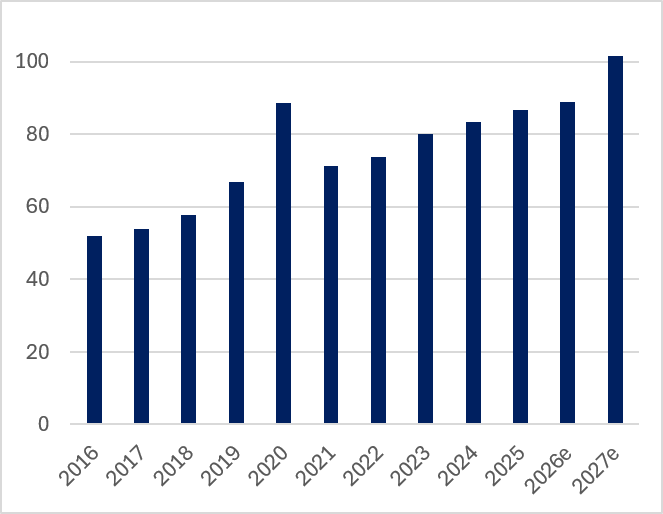
In reality, the photofinishing business has grown both revenue and earnings over the long term and could reach EBIT above 100 mEUR in 2027.
CEWE Photofinishing EBIT 2016-2027
CEWE is priced as if photofinishing were a slowly dying business. It is not. Tangible memories have value in the digital age and are highly valued gifts at a relatively low price. Studies support this: most people prefer physical photos over digital ones; personalized gifts are valued more highly than more expensive ones and bring more joy to giver and receiver alike; and physical photos build stronger memories and are more likely to be shared.
One poll found Gen Z much more likely than Boomers to turn a picture into a print. And Kodak Moments print stations’s largest customer segment is younger people. This supports the claim that physical products is not a slowly dying product used by older people.
Your phone captures nice memories, including video and music, but these translate poorly into gifts. Sending a digital picture as a Christmas present feels cheap; a physical book or calendar that costs time and money, and can be looked at together, has higher value.
AI was flagged as a concern in the refinancing of American peer Shutterfly. But photofinishing centers on personal memories, not AI-generated pictures, and AI is more likely to be a growth driver. It makes photo books much faster to set up. CEWE has run its mobile and AI campus since 2019 and keeps using AI to improve ordering, setup and photo quality.
Misconception #2: Poor corporate governance, with foundation control and cash hoarding
The foundation structure is both a concern and a long-term strength, only the concern is priced in. It also brings a long-term mindset and capital allocation that clearly stand out in the industry.
CEWE was founded in 1961 by Heinz Neumüller in Oldenburg, Germany, and the founding family still owns 27%. The structure was later changed to a Stiftung (foundation), with the Neumüller CEWE COLOR Foundation as general partner, securing control even if the family sells its shares. The foundation elects its own board, the family elects one member.
Two CEO changes in the last couple of years, and disagreements between the family shareholders and the foundation, made the governance issue clear. The family and other shareholders did not agree with replacing the CEO. The dispute became quite public.
Leadership of the foundation’s board has since changed, and the interests seem realigned (for now). The second CEO change looks like a reversal of the first.
The concern is legitimate, but the strength of the model becomes clear next to US market leader Shutterfly, which is owned by a private equity fund.
Shutterfly recently refinanced its large debt (again). Even at a 12% interest rate it had to sweeten the deal for debtholders, accepting terms that restrict its ability to pay dividends, make investments and move money beyond creditors’ reach. CEWE, by contrast, has no financial debt and a large net cash position. It returns more than 5% of its market cap to shareholders annually (3.5% dividend, 1.5% buyback) while buying Kodak Moments, investing in production and buying the last buildings it had leased.
ROCE is a central metric in CEWE report and invest, and the foundation empowers the board to reject short-term profit spikes if they threaten long-term corporate health. CEWE has been criticized for hoarding cash, but it built a war chest and waited for attractive opportunities.
The five current management team members have been with CEWE for 28, 17, 13, 13 and 1 years respectively. Only the CFO is new to the business. Despite the recent changes, this is a team with a lot of experience and consistency.
Misconception #3: The attractiveness of recent M&A
CEWE has a history of M&A as a consolidator in the European market, but had not made a major deal since 2019. They built up firepower and waited for the right opportunity. As the CEO put it: “…we select the targets we want to very carefully... we have deep pockets, good financial strength, but we have short hands.”
In the last couple of months they have done two large deals: selling the commercial printing business and buying Kodak Moments’ print station business. The Kodak acquisition was a surprise. European bolt-ons looked more likely, plugging strong local brands into CEWE’s shared production and IT platform to strengthen its position in markets where it does not lead today.
The commercial printing deal
CEWE built its commercial printing presence through acquisitions between 2008 and 2017, aiming to use its printing expertise and lift sales outside the Q4 peak season. Revenue grew to 90 mEUR, but the business never became very profitable (EBIT of 1.7 mEUR in 2025). The management points to tougher competition in this segment. In May they announced the sale to Cimpress, which looks like an attractive deal for CEWE.
The transaction value wasn’t disclosed, but the sale produced a mid-double-digit-million-euro gain on disposal. CEWE restated its ROCE and EBIT excluding the business, implying capital employed in commercial printing of roughly 62 mEUR. Assuming a gain of 15-35 mEUR, that puts the transaction value at 77-97 mEUR against CEWE’s market cap of 650 mEUR. A meaningful addition to an already large cash position, with no real hit to earnings.
The Kodak Moments deal
CEWE just announced the acquisition of Kodak Moments’ global instant photo business, a complementary footprint with strong positions in North America and Australia. It adds 37,000 connected in-store photo kiosks across 16,000 retail locations, 200 mEUR of revenue and about 10 mEUR of EBIT. CEWE’s own photofinishing revenue is around 750 mEUR, EBIT of about 83 mEUR and ~26,000 print stations. Combined, the two will have 63,000 print stations, making CEWE a global leader.
It looks reasonable as a standalone move, though a bit surprising, since CEWE had not signaled expansion outside Europe before. At an EV/EBIT of about 8x, buying back its own stock might be more attractive, unless CEWE can extract synergies or use the deal as a way to grow internationally. Both seems likely which can make the deal very attractive longer term. into the US market.
Kodak Moments mostly sells basic prints, which are low-value and very competitive online, but instant in-store availability is a real edge. The bigger opportunity is using the brand, network and US organization to sell value-added products like photo books and calendars, the way CEWE does in Europe. They could start shipping from Europe or outsourcing production before building a US plant, letting CEWE test demand before committing capital. Kodak Moments tried its own photo-book app once and shut it down. With CEWE’s expertise it might have a better chance, and Shutterfly’s restrictions on investment make it more interesting. CEWE is also likely to put more focus and investments into the Kodak business than the previous owner to realize the full potential.
The deal licenses the Kodak Moments brand rather than buying it outright.
It also includes a production facility for the consumables the instant-photo business needs, extending CEWE’s value chain.
A board of trustees member (former CEO) bought shares right after the announcement, a reasonable signal of confidence.
Selected risks
Increased competition: Many players now offer photo books, and rising online ad spending could push up customer acquisition costs, especially at the low end and among younger customers.
Platform dependence: CEWE relies on easy access to customers’ smartphone photos. If Apple or Google (Android) made it materially harder to pull photos off a phone, that would be a real threat to the business.
A ceiling on premiumization: If customers stop paying more for a photo book and CEWE can no longer raise value per photo, that removes a growth driver that has done a lot of the work over the past decade.
Execution risk: Integrating Kodak Moments and possibly building out US production is new territory for CEWE. It could disappoint like so many other acquisitions have done.
Conclusion
CEWE looks like a misunderstood case, priced like a declining print business run by a management team hoarding cash. In reality it is a growing business with strong brands and a market-leading position, earning high ROIC while waiting patiently to deploy its cash. The recent deals make it a pure play and add a cheap option on international growth.
The stock has traded sideways for the past three and a half years while the core business kept improving. At below 10x earnings and a 10% FCF yield, with net cash and attractive ROIC and cash conversion, it looks interesting.
In 2019, US market leader Shutterfly was acquired at 1.3x revenue and 8-9x EV/EBITDA, roughly twice CEWE’s current levels. Smartphoto was recently taken private at 18x earnings and 11x EV/EBIT, also a large premium to CEWE’s multiples. CEWE’s own historical average PE is about 50% higher than where it trades today.
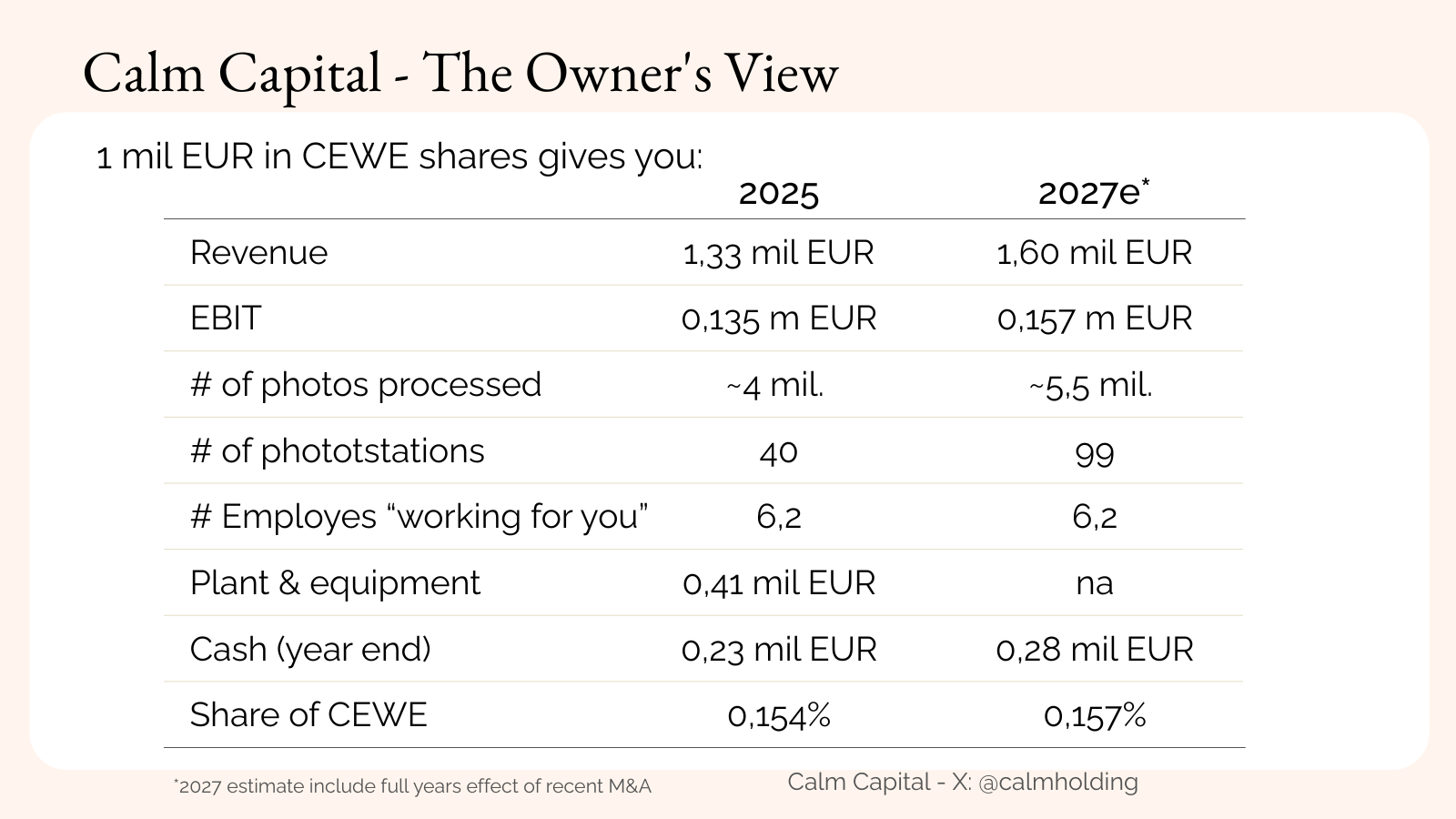
From an owner’s perspective, this is what you get if you invest €1 million in CEWE:
For more writeups subscribe or follow on X: calmholding
This is not investment advice. Do your own research and see the full disclaimer. I own shares in CEWE.